Click or Tap Button
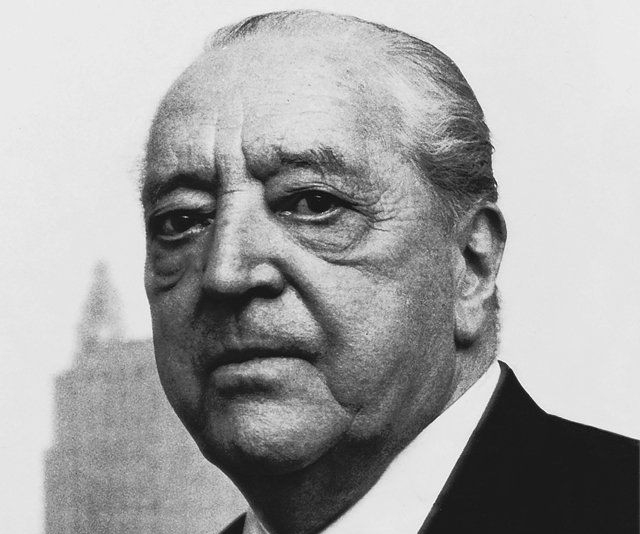
Ludwig Mies van der Rohe, a German-born architect, made revolutionary architectural designs. Prior to going it alone, he worked as a draftsman in the beginning. Mies served in the German military throughout World War I. The German Pavilion at the 1929 Barcelona Exposition was one of the buildings he built after becoming well-known in Germany as an architect. Mies immigrated to the US in the latter half of the 1930s. There, he produced such well-known Modernist creations as the Seagram Building and the Lake Shore Drive Apartments. He died in 1969.
By the mid-1920s, Mies had become a leading avant-garde architect in Germany. He was a member of the radical artistic organization Novembergruppe, and later joined the Bauhaus movement. Founded by Walter Gropius, the Bauhaus movement embraced socialist ideals as well as a functional philosophy about art and design. (The Nazis later found the work of Bauhaus to be degenerate, however, and the group shut down under political pressure).

The German Pavilion Mies built for the Barcelona Exposition in Spain is among his most remarkable creations from this time. This display edifice was a modern marvel of glass, metal, and stone that was built between 1928 and 1929. Mies departed for America in the late 1930s despite his rising fame in Germany. After relocating to Chicago, he oversaw the Illinois Institute of Technology’s architectural program and created the campus’ layout.
Highly regarded in his field, Mies was the subject of a solo exhibition at the Museum of Modern Art in New York City in 1947. He also continued to be in demand as an architect, building the Lake Shore Drive Apartments in Chicago and the Seagram Building in New York City. A joint project with Philip C. Johnson, the dark metal-and-glass 38-story skyscraper was completed in 1958.
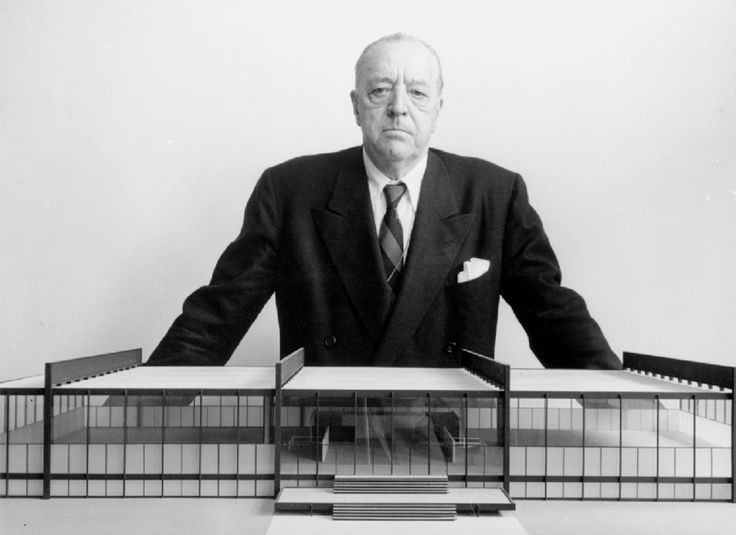
One of Mies’s final projects was the New National Gallery in Berlin, for which he had received a commission from the West German government. Completed in 1968, the structure is a testament to his Modernist aesthetic. The two-level building features walls of glass supported by an imposing metal frame. Following a lengthy battle with esophageal cancer, Mies died on August 17, 1969, in his adopted hometown of Chicago. Many of his impressive structures still stand today, wowing visitors with their innovative design. Perhaps what has made his work so enduring was his progressive design philosophy. “I have tried to make an architecture for a technological society,” he told the New York Times. “I wanted to keep everything reasonable and clear—to have an architecture that anybody can do.”
 ARCHIPEDIA