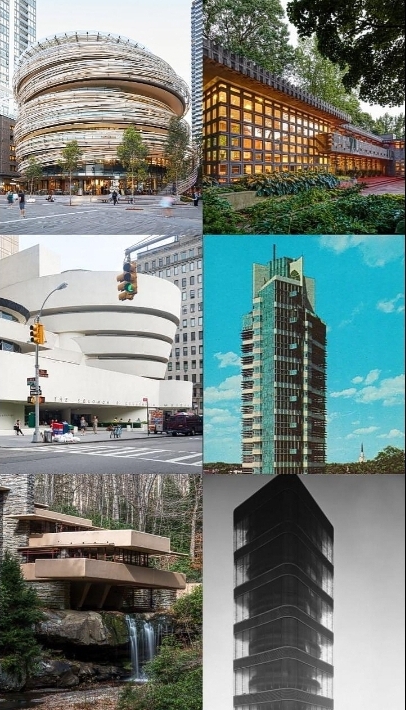
Frank Lloyd Wright, a visionary whose work continues to serve as an inspiration and the foundation upon which most of modernist architecture is based, is one of the figures who are most consistently present in American architecture. Wright’s work rethought architectural tenets with his ground-breaking Prairie-style homes, unique organic designs, and approachable Usonian models. Wright became famous during his lifetime as a result.
ARCHITECTURAL DESIGNS
Fallingwater

Arguably the most famous private home of the 20th century, this residence and its striking silhouette appearing on a career-defining cover of Time magazine in 1938 created a sensation that propelled Wright through the final decades of his career. Set atop a waterfall in Bear Run, a summer camp in western Pennsylvania owned by the wealthy Kaufmann family, the concrete-and-limestone home, entwined with the body of water that gives it its name, is a symbolic masterpiece, instructive of both Wright’s philosophy and his single-mindedness.
Price Company Tower
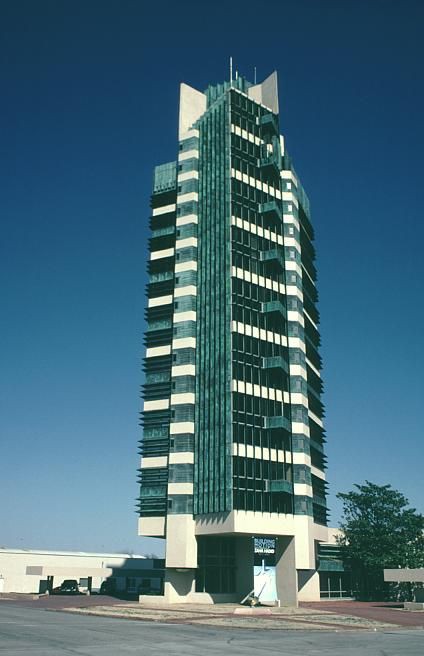
Wright described his lone high-rise as “the tree that escaped the crowded forest,” an apt way to paint a picture of this asymmetrical beauty, comprising 19 stories of angular walls that look different from every angle. Based on a design for apartments in Manhattan the architect created in the ’20s, the basic idea was transplanted to Oklahoma when Harold Price, owner of a local oil and chemical concern, hired Wright to create his first skyscraper. Opened in 1956, the copper-clad tower dominates the skyline. Visitors can now stay in a hotel in the top half of the building.
ASU Gammage Auditorium

Adapted from plans Wright created for a never-realized opera house in Baghdad, this circular auditorium is the only public Wright building in the entire state. The adaptable main stage is surrounded by a series of 50 columns connected visually via a repeating circular pattern, flanked by a pair of flying-buttress walkways. While the exterior is far from Wright’s most pleasing, the circular interior, where every seat is no more than 115 feet from the stage, is renowned for incredible acoustics.
Congregation Beth Sholom
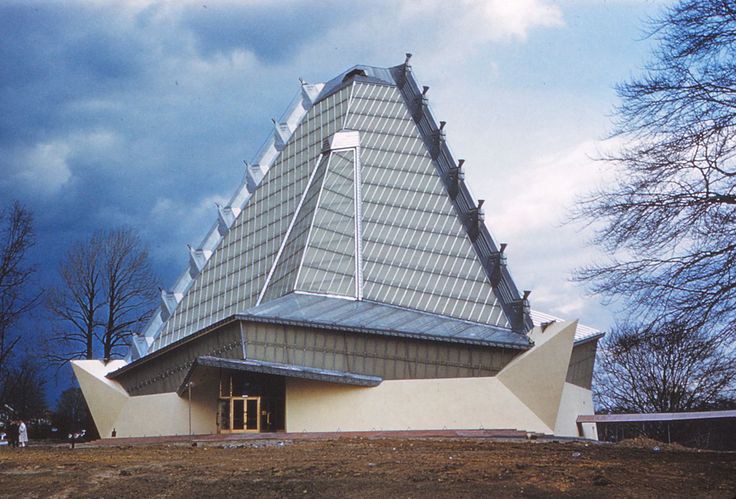
An imposing temple rising in a Philadelphia suburb, Wright’s only synagogue is a singular piece of modernist religious architecture. The grand pyramidal roof, with inclined walls of translucent fiberglass and plastic, built on three steel beams, allows light in and takes on a golden glow during the sunset. The shadows of birds flying above are visible during a sunny day. Wright’s vision references two religious metaphors suggested by the then-rabbi, Mt. Sinai and a tent, which underly his own unique take on a shared sacred space.
Solomon R. Guggenheim Museum
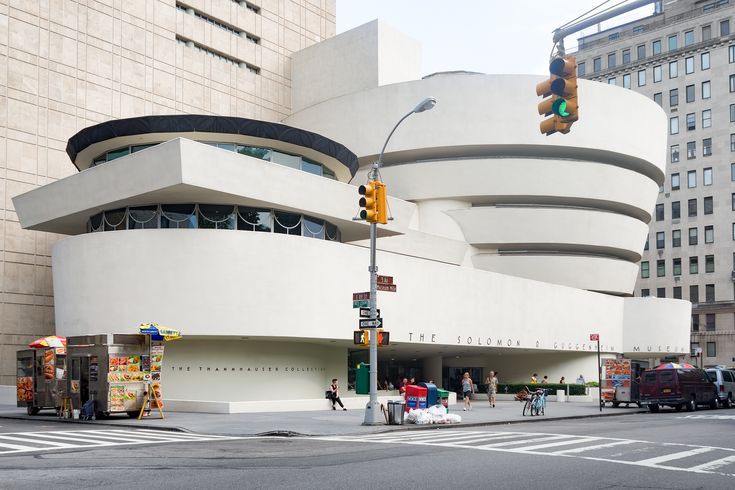
Opened six months after Frank Lloyd Wright died in 1959, the Guggenheim met with the kind of criticisms that one might imagine the architect would delight in hearing: that this incredible building was so striking, it would overshadow the art within. The apex of Wright’s cylindrical and circular style, this cultural center, a ribbon of concrete on the Upper East Side, descended from an earlier design for the Gordon Strong Automobile Objective and Planetarium. The open atrium and curved, spiraling floorplan created a unique viewing experience, with patrons slowly ascending toward the top of the architectural nautilus shell.
 ARCHIPEDIA