
With his unorthodox and dynamic use of forms, colors, and shapes throughout the course of more than 50 years as an architect, Frank Gehry has produced some of the most amazing buildings. He has won numerous honors, including the Pritzker Architecture Prize in 1989, thanks to his distinctive use of various materials and signature deconstructivist design. The manner that Frank Gehry approached developing building facades that stood out as individual works of art while yet appearing to flow smoothly with the surrounding structures altered this era’s approach to building design. The usage of the material in the field of architecture was forever altered by his distinctive metallic finishes and material flexibility.
ARCHITECTURAL DESIGNS
Walt Disney Concert Hall
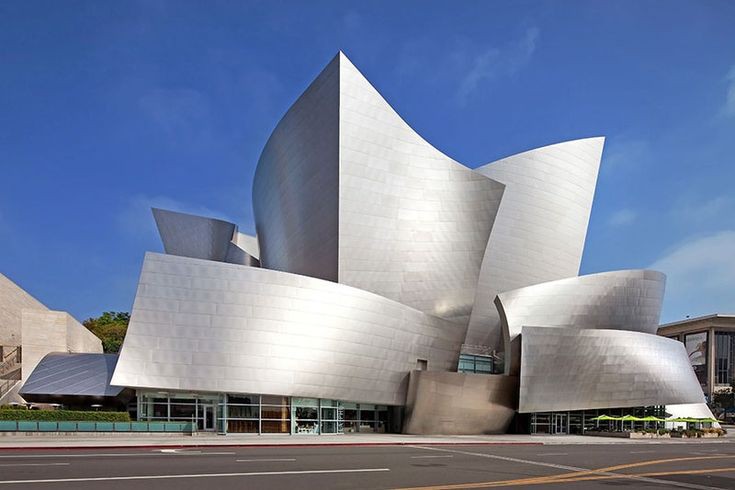
Gehry was shortlisted to devise a new home for the Los Angeles Philharmonic in 1988; the project, the Walt Disney Concert Hall, finally opened in 2003. Today critics and the public agree that the iconic building was worth the wait. Reflecting Gehry’s longtime passion for sailing, the structure’s exterior features expanses of stainless steel that billow above Grand Avenue, while inside, similarly shaped panels of Douglas fir line the auditorium.
Olympic Fish Pavilion
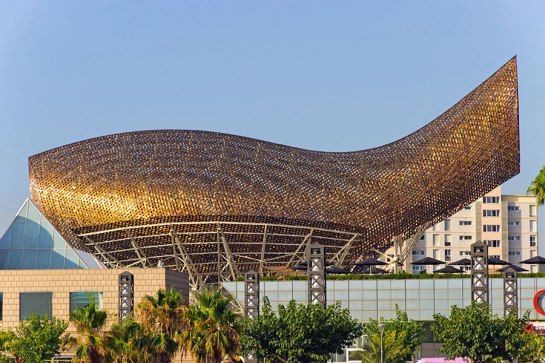
For the 1992 Olympic Village in Barcelona, the enormous golden steel-mesh fish sculpture Gehry produced was a technological milestone for the architect’s team, which employed three-dimensional aeronautical-design software to actualize the concept.
Neuer Zollhof
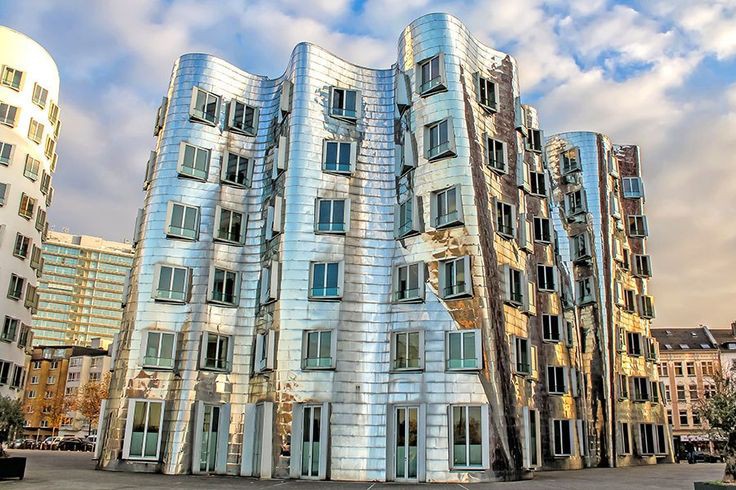
In 1999, Gehry’s Neuer Zollhof complex inspired the development of what is now known as the Media Harbour on the riverfront in Düsseldorf, Germany. The three office towers’ popularity led to neighboring commissions for other well-known designers including Fumihiko Maki and Murphy/Jahn, and the three skyscrapers were included in the German edition of Monopoly.
Beekman Tower
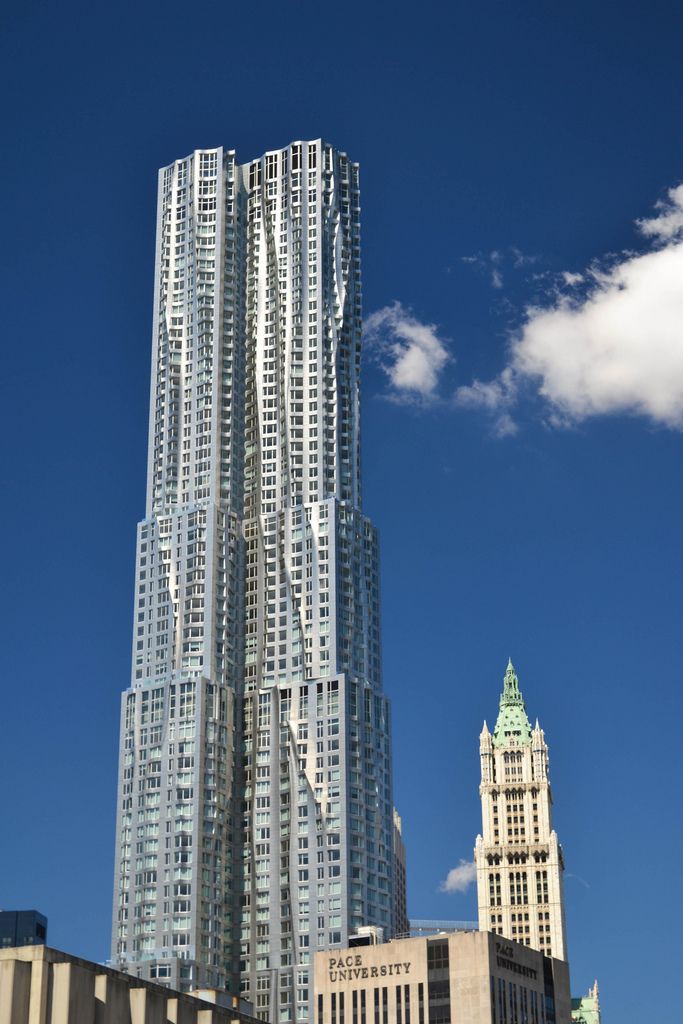
Beekman Tower in Manhattan, also known as 8 Spruce Street, has ripples running over its exterior, as if a large Super Ball had ricocheted through it. Residents of the 76-story apartment building, which was built by the construction company Forest City Ratner Co. and opened in 2011, can also use these pleats as bay windows.
Guggenheim Bilbao
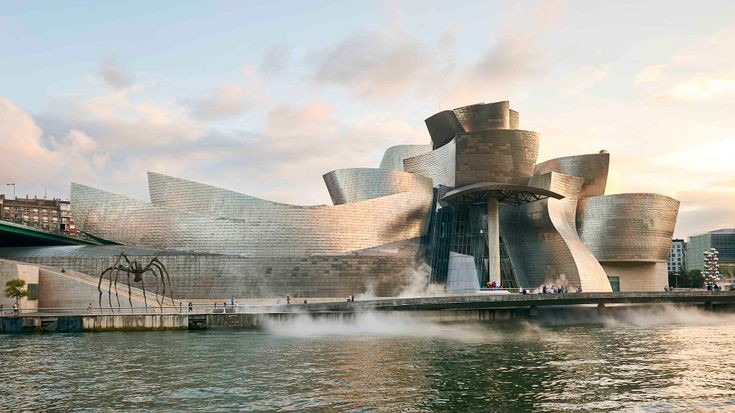
In a mountain of stone, glass, and titanium that follows the curves of the Nervión river, the Guggenheim satellite in Bilbao, Spain, quadrupled the museum’s exhibition area. The Guggenheim Bilbao’s design and construction received little news coverage, thus the building’s 1997 unveiling resulted in a media frenzy that cemented Gehry’s reputation as a master architect and jolted Bilbao’s economy.
Stata Center

The Ray and Maria Stata Center for Computer, Information and Intelligence Sciences replaced Massachusetts Institute of Technology’s Building 20 in 2004. Its predecessor had enjoyed mythological status as a place where scientists engaged in unexpected yet highly successful collaborations. Gehry designed the Stata Center specifically to encourage occupants to interact with one another.
Dancing House
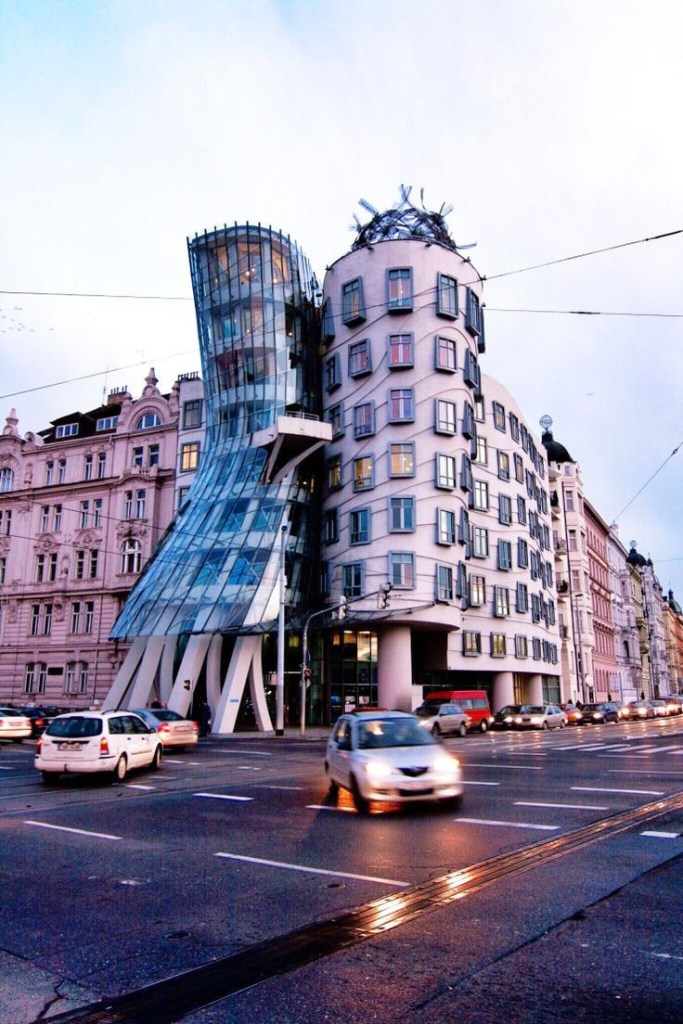
Due to its distinctive pair of towers, which resemble a dancing couple, the Nationale-Nederlanden offices in Prague are also known as Fred and Ginger. In 1996, Gehry and a local architect named Vlado Milunc collaborated to create the building, which was made out of a tight volume of metal mesh and glass and a concrete cylinder.
Cinémathèque Française
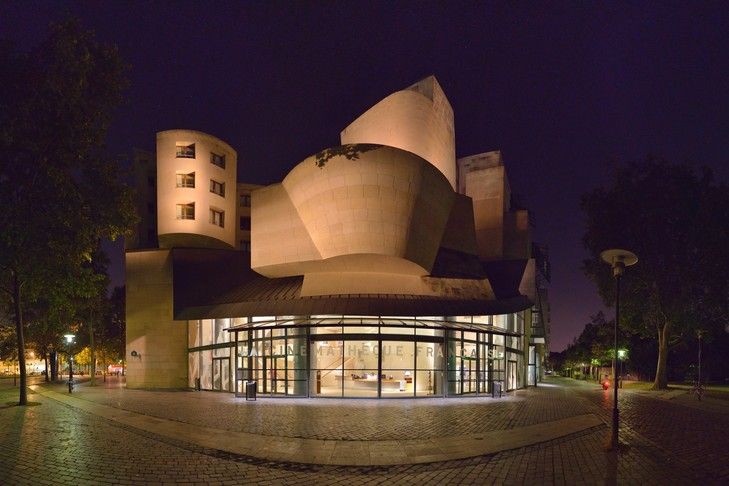
Gehry’s building along Paris’s rue de Bercy opened in 1994 as the headquarters of the American Center of Paris, but closed a year and a half later. In 2005 it became home to the Cinémathèque Française, a theater and archive of film history.
Marqués de Riscal

Gehry’s first finished hotel, The Marqués de Riscal, was constructed in 2006. A little town with vineyards and wineries is home to the opulent accommodations. Marqués de Riscal has increased the number of visitors to this area of the nation, much to how Gehry’s Guggenheim Museum Bilbao revitalized that Spanish city.
Fondation Louis Vuitton
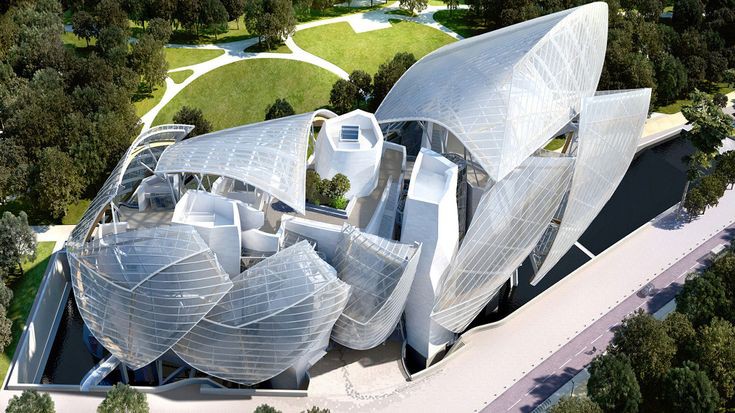
Commissioned by LVMH chief Bernard Arnault and completed in 2014, Frank Gehry’s Fondation Louis Vuitton is set in Paris’s Bois de Boulogne park. The shiplike exterior includes 12 glass “sails,” which cover the concrete-clad gallery spaces.
 ARCHIPEDIA