Click or Tap Button
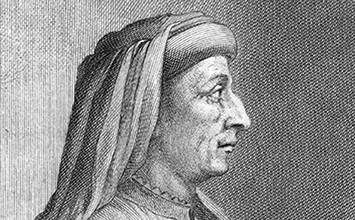
Brunelleschi was born in Florence, Italy, in 1377. His parents were Giuliana Spini and Giulio Spini; his two brothers were also present. The family was prosperous; the Spini family palace can still be seen in Florence, right next to the Church of the Trinita. The young Filippo was given a literary and mathematical education in order to enable him to follow in the footsteps of his father. However, Filippo was artistically inclined and, at the age of fifteen, was apprenticed to the Arte della Seta, the guild of wool merchants, which was also comprised of jewelers and metalworkers and was the richest and most renowned guild in the city. He started working as a great jeweler and sculptor in December 1398.
In 1401, Brunelleschi fought for the job of creating the bronze reliefs for the door of the Florence baptistery with a young opponent, Lorenzo Ghiberti, and five other sculptors. Ghiberti was given the job despite Brunelleschi’s entry, “The Sacrifice of Isaac,” which was the pinnacle of his brief career as a sculptor. With the assistance of Donatello, a towering figure from the Renaissance, Ghiberti went on to build a second set of bronze doors for the baptistery. Michelangelo remarked of the doors a century later, “Surely these must be the “Gates of Paradise.”
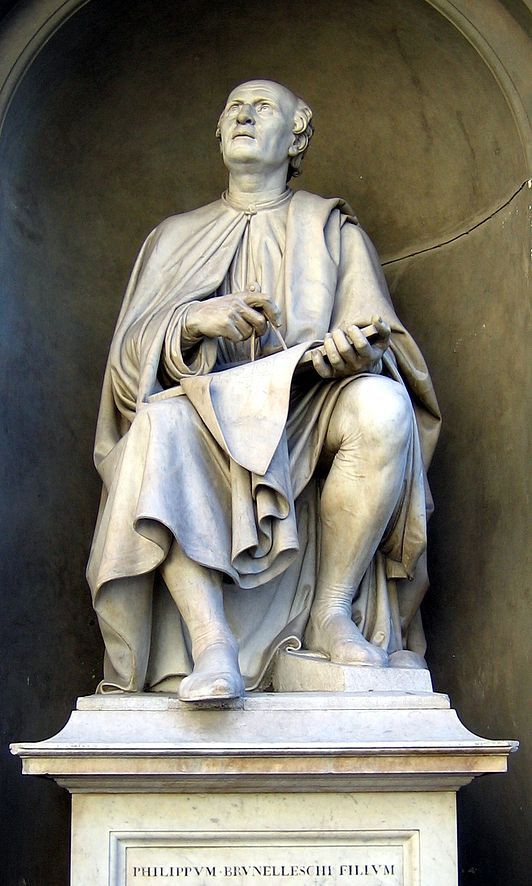
Brunelleschi’s diverse skills also included the ability to solve challenging engineering and statics challenges. The best examples of Brunelleschi’s technological prowess are the machinery he developed to build the towering dome of the Duomo and its lantern, a structure placed on top of the dome to assist illuminate the inside, as well as his plan for the construction itself. The cathedral’s construction began in 1296; the nave was finished in the 14th century, and work on the intricate octagon at the east end got under way.
By 1418, work had advanced to the point that a vault over the massive octagon had to be built, posing a number of technical challenges. Older generations of cathedral architects had fought vehemently over these issues. Brunelleschi developed an effective vaulting technique for the dome, created the machinery needed to perform it, and created the structure’s crowning lantern and lateral tribunes (semicircular structures). He assumed the position of dome project’s head architect (capomaestro) in 1420 and held it until his death in 1446.

On April 15, 1446, Brunelleschi passed away in Florence and was interred in the Duomo. One of the titans of Renaissance architecture, he is well-known. The inscription on his grave inside the basilica reads “A grateful country that will always remember buries him here in the soil below in tribute to his exceptional talents, as both the magnificent dome of this famous church and many other inventions by Brunelleschi the architect bear witness to his superb skill.”
 ARCHIPEDIA